For the first time in almost 1,000 years
70 metres of linen and wool. 58 embroidered scenes. The story of 1066 and the Norman Conquest of England.
10 September 2026 – 11 July 2027
until the exhibition opens · 10 September 2026
Unofficial guide. This site is not affiliated with, or endorsed by, the British Museum or the Musée de la Tapisserie de Bayeux. Read our disclaimer.
The Bayeux Tapestry is one of the most remarkable surviving artefacts from the Middle Ages. Created in the 1070s, within a decade of the events it depicts, it tells the story of the Norman Conquest of England in 1066 through 58 embroidered scenes on a strip of linen nearly 70 metres long.
The narrative begins with Edward the Confessor, King of England, sending Harold Godwinson on a mission to Normandy. It shows Harold's shipwreck, his meeting with Duke William of Normandy, and the famous oath Harold swears to William, an oath whose breaking would later be used to justify William's invasion of England.
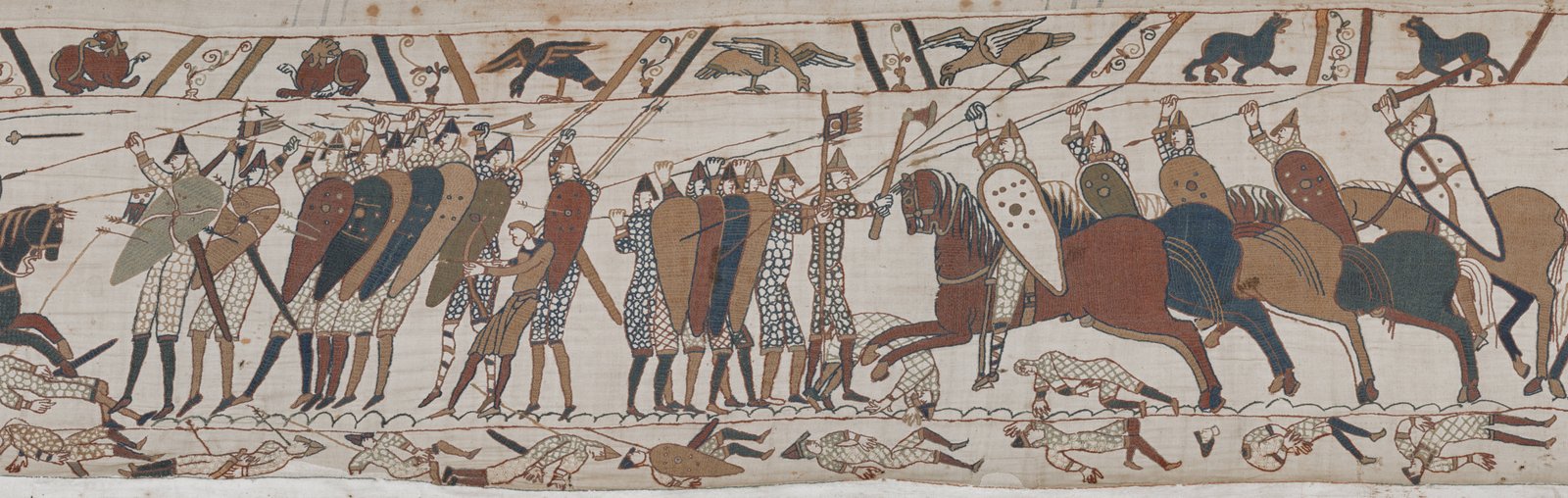
The tapestry culminates in the Battle of Hastings on 14 October 1066, where Harold is killed and William claims the English throne. The final scenes show the English in flight and the Normans in pursuit, though the tapestry's ending is now lost or incomplete.
For nearly a thousand years, the Bayeux Tapestry has remained in France. Its journey to the British Museum in 2026 will mark the first time it has been displayed in Britain since the events it depicts, a once-in-a-millennium opportunity to see this masterpiece on the soil where the story unfolded.
Discover the key moments embroidered into this medieval masterpiece
Harold swears an oath to William, a pivotal moment that would later be used to justify the Norman invasion.
Explore this scene →Halley's Comet appears in 1066, interpreted as an omen of doom for King Harold and the English.
Explore this scene →The climactic battle on 14 October 1066, where Harold falls and William claims the English throne.
Explore this scene →Dive deeper into the history behind the tapestry
The year that changed England forever. Three battles, two invasions, and three kings in twelve months.
Read the full timeline →The patron, the designer, and the embroiderers. What we know, what we guess, and what we will never know.
Read the article →14 October 1066. How the battle unfolded, hour by hour, from the first arrow to the last stand.
Read the article →Nearly a thousand years of wars, revolutions, and close calls. The story of the tapestry's extraordinary survival.
Read the article →The last Anglo-Saxon king. Warrior, politician, oath-breaker, tragic hero.
Read the article →The Bayeux Tapestry is normally kept in Bayeux, Normandy, France.
The British Museum exhibition is scheduled to run from 10 September 2026 to 11 July 2027.
No. Although it is known as the Bayeux Tapestry, it is technically embroidery, stitched in wool thread onto linen cloth.
The tapestry is commonly divided into 58 scenes, although scene numbering can vary depending on the source or guide being used.