The Bayeux Tapestry,
Scene by Scene
Explore all 58 embroidered scenes, their Latin inscriptions,
modern translations and the story of 1066.
Listen to the Bayeux Tapestry, scene by scene
Start with the introduction for a practical guide to the embroidery, its colours, borders and visual layout. Then play any scene individually as you move through the guide.
The introduction explains how the embroidery is arranged before Scene 1 begins.
About this guide. The Bayeux Tapestry tells the story of the Norman Conquest of 1066 in 58 embroidered scenes, nearly 70 metres of wool on linen. This guide follows the official 58 scene numbering used by the Bayeux Tapestry Museum, the numbers written on the tapestry's backing cloth around 1800. Spelling follows the stitching itself, with abbreviated letters restored in square brackets. The tapestry spells William four different ways, so don't be alarmed. Source numbers after each scene link to the bibliography at the end.
Timeline Navigation
Jump directly to any of the 58 scenes.
Part One. Harold's Journey (Scenes 1 to 15)
Scene 1
EDWARD[US] REX
"King Edward."
"King Edward."
Old King Edward the Confessor sits on his throne, deep in conversation with two men. One of them is Harold Godwinson, Earl of Wessex, the most powerful man in England after the king. Whatever Edward is saying sets the whole story in motion.
(Edward had no children, which meant no heir, which meant trouble. Here's a secret hiding in plain sight. The word EDWARD is not original. It was added by restorers centuries later, and the tapestry spells his name Eadwardus everywhere else.)
 Back
BackScene 2
UBI HAROLD DUX ANGLORUM ET SUI MILITES EQUITANT AD BOSHAM
"Where Harold, duke of the English, and his soldiers ride to Bosham."
"Harold, Earl of Wessex, rides with his men to Bosham."
Harold sets off for the Sussex coast in style. A hawk perched on his wrist and a pack of hounds running ahead.
(The hawk and hounds are the medieval equivalent of travelling in a soft top with the golf clubs in the back. This is a man on holiday, not a man going to war. The Latin calls Harold dux, the same word it uses for Duke William, quietly putting the two rivals on equal footing.)
Scene 3
ECCLESIA[M]
"The church."
"Bosham church."
Harold pops into Bosham's church to pray for a safe crossing, then enjoys a hearty feast in the hall upstairs with plenty of drink before boarding.
(Praying before a Channel crossing was simply good sense, people drowned doing it all the time. The feasters drink from horns, which cannot be put down until empty. Bosham church is still standing today, and you can visit it.)
Scene 4
HIC HAROLD MARE NAVIGAVIT
"Here Harold sailed the sea."
"Harold sets sail."
Harold's men hitch up their tunics and wade bare legged out to the ships, and off they go across the Channel.
(Here is the great mystery of the whole tapestry. It never says why Harold sailed. Norman writers claimed Edward sent him to promise the throne to William. English writers said he was on his own business, possibly rescuing family hostages. The tapestry, never reveals the actual reason for his journey, leaving it open to debate.)
Scene 5
ET VELIS VENTO PLENIS VENIT IN TERRA WIDONIS COMITIS
"And with sails full of wind he came into the land of Count Wido."
"With sails full of wind, he lands in the territory of Count Guy."
Disaster. Harold lands in the wrong place, the territory of Count Guy of Ponthieu rather than Normandy.
(Wido is the Latin form of Guy. By the cheerful coastal custom of the day, anyone washed up on your shore could be legally seized and ransomed, rather like a parking clamp that applies to people. Harold has just stepped into a trap.)
Scene 6
HAROLD
"Harold."
"Harold."
Harold steps ashore, still clutching his hawk, and finds armed men waiting for him.
(Watch the hawk through the next scenes. It passes from Harold to his captors, a wordless way of showing who owns whom.)
Scene 7
HIC APPREHENDIT WIDO HAROLDU[M]
"Here Wido seized Harold."
"Count Guy arrests Harold."
Guy of Ponthieu takes England's most powerful earl prisoner. For a small-time count with no real stature, this is like finding a winning lottery ticket on the beach.
(Harold isn't roughed up or chained. As a great lord he was held politely, like an expensive hotel guest who isn't allowed to check out, while his ransom was negotiated.)
Scene 8
ET DUXIT EUM AD BELREM ET IBI EUM TENUIT
"And led him to Beaurain and there held him."
"Guy takes Harold to Beaurain castle and holds him there."
Guy escorts his prize catch inland to his stronghold at Beaurain.
(One rider glances backwards, a trick the designer uses constantly to pull your eye along the 70 metres, like a film camera panning to the next shot.)
Scene 9
UBI HAROLD ET WIDO PARABOLANT
"Where Harold and Wido talk."
"Harold and Guy hold talks."
Guy sits with a sword held upright while Harold, presumably, discusses the price of his freedom.
(The word parabolant is pure medieval Latin, the ancestor of the French parler and the English parley. A Roman would not have recognised it. It is one of the clearest medieval fingerprints in the whole text.)
Scene 10
UBI NUNTII WILLELMI DUCIS VENERUNT AD WIDONE[M]. TUROLD
"Where the messengers of Duke William came to Wido. Turold."
"Duke William's messengers arrive at Guy's court. Turold."
Word of Harold's capture has reached Duke William of Normandy, who sends two messengers to Guy demanding the prisoner release. A small, bearded figure named Turold holds their horses.
(Nobody knows who Turold is. He is one of only a handful of named people in the tapestry, most of whom are kings, dukes and bishops, and yet here is a groom or dwarf getting his name in lights. Some think he was a favourite of the tapestry's patron, others that he was its designer sneaking in a signature.)
Scene 11
NUNTII WILLELMI
"The messengers of William."
"William's messengers ride at full gallop."
The two messengers thunder along at full stretch, hair streaming, trees bending.
(Sharp eyed viewers will notice this is a flashback. It shows the urgent ride that happened in the previous scene. The tapestry occasionally shuffles time for drama, a thousand years before cinema invented the same trick.)
Scene 12
HIC VENIT NUNTIUS AD WILGELMUM DUCEM
"Here a messenger came to Duke Wilgelm."
"A messenger brings Duke William the news."
William, enthroned, hears about Harold's capture. This is his first appearance, and he means business.
(Spot the haircuts. Normans are clean shaven with the backs of their heads shaved high, while Englishmen wear moustaches and longer hair. The designer uses grooming as team strips, so you can always tell the sides apart. A small, stitched cross appears before this caption, possibly marking where a new embroidery workshop took over.)
Scene 13
HIC WIDO ADDUXIT HAROLDUM AD WILGELMUM NORMANNORUM DUCEM
"Here Wido led Harold to Wilgelm, duke of the Normans."
"Guy hands Harold over to William, Duke of Normandy."
Guy, no doubt paid off or leaned on, delivers Harold to William in person, pointing back at his former prisoner like a man handing over a parcel.
(Harold has swapped an obvious prison for a luxurious one. He is now William's honoured guest, which sounds lovely until you realise that guests of this kind cannot leave.)
Scene 14
HIC DUX WILGELM[US] CUM HAROLDO VENIT AD PALATIU[M] SUU[M]
"Here Duke Wilgelm came with Harold to his palace."
"Duke William brings Harold to his palace."
William and Harold arrive at the ducal palace, probably in Rouen, where Harold gestures expansively as he talks.
(What did they discuss? Nobody knows, and everything that follows hangs on it. The tapestry is full of pointing, touching and gesturing figures, a sign language its first audience could read fluently and we mostly cannot.)
Scene 15
UBI UNUS CLERICUS ET ÆLFGYVA
"Where a certain cleric and Ælfgyva..."
"Where a priest and Ælfgyva..."
A priest reaches out and touches the face of a woman called Ælfgyva, who stands framed in a doorway. In the border below, a naked man crouches in a rude pose that mimics the priest's gesture.
(This is the tapestry's juiciest mystery. The caption has no verb, it just trails off, as if everyone at the time knew exactly what scandal was being referred to. A thousand years later, nobody has a clue. Ælfgyva is an English name, the naked man below suggests something saucy, and dozens of theories have been published. It is the medieval equivalent of a tabloid headline where the story underneath has been lost.)
Part Two. The Brittany Campaign and the Oath (Scenes 16 to 24)
Scene 16
HIC WILLEM[US] DUX ET EXERCITUS EIUS VENERUNT AD MONTE[M] MICHAELIS
"Here Duke Willem and his army came to the Mount of Michael."
"Duke William and his army arrive at Mont-Saint-Michel."
William takes his army, with Harold riding along, on campaign against Conan, Duke of Brittany. They pass the famous island abbey of Mont-Saint-Michel.
(Why drag your prize guest to a war? Partly to show off Norman muscle, partly to keep him where you can see him, and partly to size him up. The abbey on its rock is instantly recognisable today.)
Scene 17
ET HIC TRANSIERUNT FLUMEN COSNONIS. HIC HAROLD DUX TRAHEBAT EOS DE ARENA
"And here they crossed the river Couesnon. Here Duke Harold was dragging them from the sand."
"They cross the River Couesnon, and Harold pulls men out of the quicksand."
Crossing the river mouth, soldiers blunder into quicksand. Harold, drawn larger than life, hauls one man out by the wrist while carrying another on his back.
(The quicksand of the bay is genuinely lethal and still catches people today. This is Harold's superhero moment, and it is striking that a Norman monument gives it to him. The designer builds Harold up deliberately, because a story about a great man's downfall is far better than a story about a villain's.)
Scene 18
ET VENERUNT AD DOL ET CONAN FUGA VERTIT. REDNES
"And they came to Dol, and Conan turned in flight. Rennes."
"They reach Dol, and Duke Conan runs for it. Rennes."
The Normans arrive at the town of Dol, and Conan of Brittany escapes by shinning down a rope from the tower.
(The rope escape is almost certainly mockery rather than reporting. Conan probably just withdrew his forces, but the image makes him look like a man fleeing out of a bedroom window. The little castles on their earth mounds are the famous motte and bailey type that the Normans would soon plant all over England.)
Scene 19
HIC MILITES WILLELMI DUCIS PUGNANT CONTRA DINANTES
"Here the soldiers of Duke William fight against the men of Dinan."
"Duke William's knights attack Dinan."
The Norman cavalry assault the castle of Dinan while attackers hold flaming torches to the wooden walls.
(Setting fire to the fortifications was standard practice. Timber castles went up fast and burned down faster.)
Scene 20
ET CUNAN CLAVES PORREXIT
"And Cunan handed over the keys."
"Conan surrenders the keys."
Conan gives up, passing the keys of the town to William on the tip of his lance, which William receives on the tip of his own.
(Key exchange by lance point looks comical but is deadly serious. Neither man trusts the other within sword's reach. It is a surrender conducted at maximum possible distance, like a hostage exchange in a thriller.)
Scene 21
HIC WILLELM[US] DEDIT ARMA HAROLDO
"Here Willelm gave arms to Harold."
"William presents Harold with arms and armour."
After the campaign, William formally presents Harold with weapons and armour, placing a helmet on his head.
(This looks like a generous gift, and that's the trap. Giving arms was how a lord made a man his vassal, his sworn subordinate. To Norman eyes Harold has just accepted William as his boss. Whether Harold saw it that way, or felt he could refuse while effectively a hostage, is the moral knot at the centre of the whole story.)
Scene 22
HIE [sic] WILLELM[US] VENIT BAGIAS
"Here Willelm came to Bayeux."
"William comes to Bayeux."
William leads his company to the city of Bayeux, with Harold in tow.
(Two things to enjoy here. First, the embroiderers misspelled the very first word, stitching HIE instead of HIC. Second, the location is suspicious. Other sources say Harold's famous oath happened elsewhere, but the tapestry says Bayeux, which just happens to be the city of Bishop Odo, the man who almost certainly paid for the tapestry. Funny, that.)
Scene 23
UBI HAROLD SACRAMENTUM FECIT WILLELMO DUCI
"Where Harold made a sacred oath to Duke Willelm."
"Harold swears a sacred oath to Duke William."
The pivotal moment of the entire tapestry. Harold stands with one hand on each of two reliquaries, boxes containing the bones of saints, and swears an oath while William watches from his throne.
(Swearing on relics was the most binding promise the medieval world knew. Break it and you didn't just break your word you insulted the saints themselves and put your soul on the line. What exactly did Harold swear? The tapestry doesn't say. Normans claimed he promised to back William's claim to the English throne. And notice what is missing from the picture, any hint that Harold was swearing under duress. Every viewer would have known he was not a free man at the time.)
Scene 24
HIC HAROLD DUX REVERSUS EST AD ANGLICAM TERRAM
"Here Duke Harold returned to English land."
"Harold sails home to England."
Released at last, Harold crosses the Channel home, watched by a lookout shading his eyes from an English clifftop building.
(Compare Harold's body language from here on with the swaggering hawk carrying lord of Scene 2. The story is starting to weigh on him.)
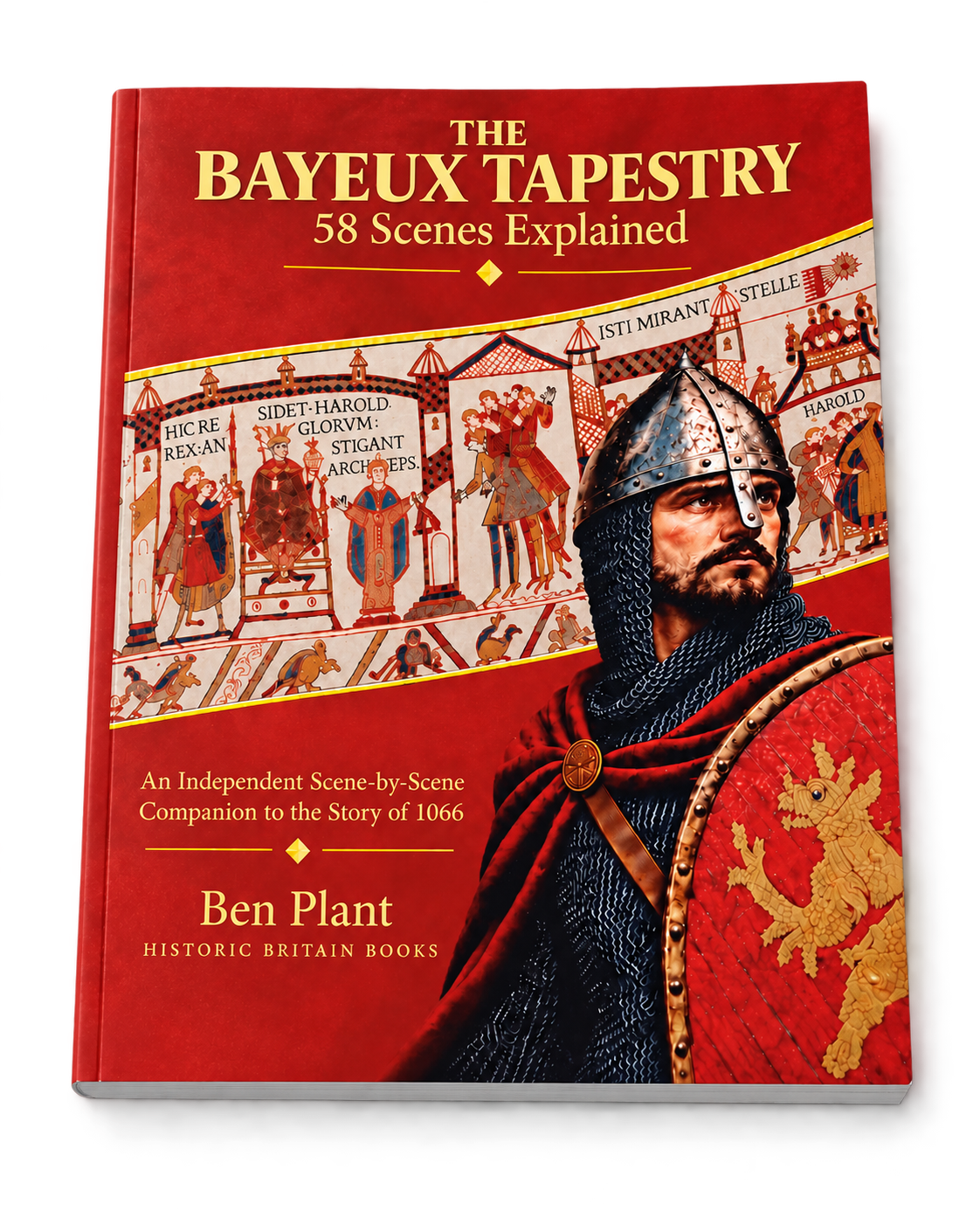
You have reached Scene 24, there are 34 still to come
The paperback follows all 58 scenes in order, with the images, inscriptions, modern translations and explanations together in one full-colour guide.
(paid link)
Part Three. A Crown Changes Hands (Scenes 25 to 34)
Scene 25
ET VENIT AD EDWARDU[M] REGEM
"And he came to King Edward."
"Harold reports back to King Edward."
Harold stands before the old king, shoulders hunched, head slightly bowed, while Edward lectures him with a raised finger.
(No words are recorded, but the body language is doing a lot of work. Harold looks like a teenager explaining what happened to the car. Was Edward furious that Harold had sworn away the kingdom? The tapestry shows the telling off and lets you supply the script.)
Scene 26
HIC PORTATUR CORPUS EADWARDI REGIS AD ECCLESIAM S[AN]C[T]I PETRI AP[OSTO]LI
"Here the body of King Eadward is carried to the church of Saint Peter the Apostle."
"King Edward's body is carried to Westminster Abbey."
A funeral procession bears the shrouded king towards a magnificent new church, while the hand of God reaches down from heaven above it. A workman is still fixing the weathercock to the roof.
(Two oddities. The church is Westminster Abbey, Edward's own pet project, consecrated only days before he died, hence the workman still up a ladder. And yes, you are seeing the funeral before the death. The tapestry deliberately runs these two scenes in reverse so that Edward's deathbed sits right next to Harold taking the crown. It is editing, not error.)
Scene 27
HIC EADWARDUS REX IN LECTO ALLOQUIT[UR] FIDELES
"Here King Eadward in bed addresses his faithful ones."
"On his deathbed, King Edward speaks to his trusted men."
The dying Edward, propped up in bed, reaches out and touches the hand of a man understood to be Harold. His wife Edith weeps at the foot of the bed.
(That touch of hands is one of the most argued about gestures in English history. English sources said the dying king entrusted the kingdom to Harold, and a deathbed wish trumped everything. Normans said nothing could trump Harold's oath. The tapestry shows the exact gesture both sides fought over and refuses to referee.)
(This scene and Scene 28 share a single image in the tapestry. The designer stacked both moments into one frame, the dying king above and his body being prepared below, so you are looking at the same section of embroidery in both scenes.)
Scene 28
ET HIC DEFUNCTUS EST
"And here he is dead."
"And here he has died."
Below the deathbed, in the same frame, the king's body is prepared for burial. Edward dies on 5 January 1066.
(Living king above, dead king below, stacked in a single image. It is the most sophisticated piece of visual storytelling in the tapestry, a before and after in one picture.)
(This scene and Scene 27 share a single image in the tapestry. The designer stacked both moments into one frame, the dying king above and his body being prepared below, so you are looking at the same section of embroidery in both scenes.)
Scene 29
HIC DEDERUNT HAROLDO CORONA[M] REGIS
"Here they gave Harold the king's crown."
"They offer Harold the crown."
Two nobles present Harold with the crown and a ceremonial axe.
(Note the speed. Edward died on 5 January and Harold was crowned on 6 January, possibly in the same church the funeral had just left. A kingdom without a king was an open invitation to invaders, so haste made sense, but to Norman eyes it looked like an indecent scramble. Note also the caption's slippery little word, THEY gave him the crown. Who exactly? It doesn't say.)
Scene 30
HIC RESIDET HAROLD REX ANGLORUM
"Here sits Harold, king of the English."
"Harold is enthroned as King of the English."
Harold sits crowned in full majesty with orb and sceptre, the picture of a king.
(Enjoy it while it lasts, Harold. He will reign for 282 days.)
(This scene and Scene 31 share a single image in the tapestry. Harold sits enthroned while Stigand stands beside him, both figures stitched into the same section of cloth, so you are looking at the same image in both scenes.)
Scene 31
STIGANT ARCHIEP[ISCOPU]S
"Archbishop Stigand."
"Archbishop Stigand."
Beside the newly crowned king stands Archbishop Stigand of Canterbury, arms spread in his vestments.
(This is character assassination by embroidery. Stigand was a notorious churchman who had been excommunicated by no fewer than five popes. By placing him, carefully labelled, next to the new king, the tapestry whispers that Harold's coronation was performed by a dodgy priest and therefore didn't count. English sources insist a perfectly respectable archbishop, Ealdred of York, actually did the crowning. The tapestry never says Stigand performed the ceremony. He just stands there, radiating insinuation.)
(This scene and Scene 30 share a single image in the tapestry. Harold sits enthroned while Stigand stands beside him, both figures stitched into the same section of cloth, so you are looking at the same image in both scenes.)
Scene 32
ISTI MIRANT[UR] STELLA[M]
"These men marvel at the star."
"A crowd gawps at the star."
A huddle of men point in amazement at a blazing star with a streaming, feathered tail crossing the sky. It is Halley's Comet, which appeared in late April 1066.
(To medieval minds a comet was never good news. It meant God was unhappy, kings would fall, the order of things was about to break. Appearing months after Harold took the crown, it was read all over Europe as a verdict on him. This is one of the earliest pictures of Halley's Comet ever made. The very word disaster means ill starred.)
Scene 33
HAROLD
"Harold."
"Harold."
A messenger whispers news of the comet to King Harold, who twists nervously on his throne. In the border beneath him floats a fleet of ghostly, empty ships.
(Those pale ships are pure genius. They are the invasion fleet that does not exist yet, drifting through Harold's imagination, the future leaking into the margins of the present. It is the single most cinematic image in the tapestry.)
Scene 34
HIC NAVIS ANGLICA VENIT IN TERRAM WILLELMI DUCIS
"Here an English ship came into the land of Duke Willelm."
"An English ship arrives in Normandy."
A single English vessel crosses the Channel to William's territory, carrying the news that changes everything. Harold has taken the crown.
(Who is aboard, a spy, a tattletale, a defector? The tapestry doesn't care. What matters is that William now knows.)
Part Four. Invasion (Scenes 35 to 47)
Scene 35
HIC WILLELM[US] DUX JUSSIT NAVES [A]EDIFICARE
"Here Duke Willelm ordered ships to be built."
"Duke William orders an invasion fleet built."
William confers with a tonsured churchman, almost certainly his half-brother Bishop Odo, and gives a shipwright his orders. Men are already felling trees and shaping planks.
(This little conversation kicks off one of the great logistical feats of the Middle Ages, building, crewing and supplying a fleet of several hundred ships in about seven months. Notice Odo advising at the crucial moment, before he has even been formally named. The man paying for the tapestry keeps turning up at all the best bits.)
Scene 36
HIC TRAHUNT NAVES AD MARE
"Here they drag the ships to the sea."
"The ships are hauled down to the sea."
Workmen drag the finished hulls to the water with ropes over log rollers.
(The tools in these scenes, broad axes, adzes and augers, match Viking age tools dug up by archaeologists, almost exactly. Historians treat these stitches as serious evidence for how 11th century ships were really built.)
Scene 37
ISTI PORTANT ARMAS AD NAVES ET HIC TRAHUNT CARRUM CUM VINO ET ARMIS
"These men carry arms to the ships, and here they drag a cart with wine and arms."
"Men load weapons aboard and haul a cart laden with wine and arms."
A procession of men carry mail shirts slung on poles, plus swords, helmets and spears, while others drag a cart bearing a huge barrel of wine.
(Mail shirts weighed around twelve kilos, hence the two-man pole system, like carrying a heavy rug. And the wine is not a party. Wine was the safe, reliable drink for an army abroad. The Latin here contains a schoolboy error, armas instead of arma, which suggests whoever wrote it was thinking partly in everyday speech rather than textbook Latin.)
Scene 38
HIC WILLELM[US] DUX IN MAGNO NAVIGIO MARE TRANSIVIT ET VENIT AD PEVENESÆ
"Here Duke Willelm in a great ship crossed the sea and came to Pevensey."
"Duke William crosses the Channel in his great ship and lands at Pevensey."
The invasion fleet at sea, decks packed with men and horses, sails bellying in the wind. William's flagship leads with a lantern at the masthead.
(The fleet sailed overnight on 27 to 28 September 1066 and landed completely unopposed. Where was the English army? Up north. Days earlier Harold had been forced to march to Yorkshire to destroy a separate Viking invasion at Stamford Bridge. William's luck here was outrageous. Look at the horses' heads peeping over the ships' sides. Shipping warhorses across the sea was difficult and rarely attempted, and those horses were about to win the battle.)
Scene 39
HIC EXEUNT CABALLI DE NAVIBUS
"Here the horses go out from the ships."
"The horses are unloaded."
Horses leap and splash ashore from the beached ships.
(The Latin word here is caballi, not the classical equi. Caballus was the ordinary bloke's word for a horse, and it grew up to become the French cheval and the English cavalry and chivalry. The tapestry speaks street Latin when it feels like it.)
Scene 40
ET HIC MILITES FESTINAVERUNT HESTINGA UT CIBUM RAPERENTUR
"And here the soldiers hurried to Hastings so that food might be seized."
"The soldiers hurry to Hastings to grab food."
Norman knights ride out to strip the Sussex countryside of everything edible.
(The caption is refreshingly honest, the verb rapere means to seize or plunder, no pretence that anyone paid. It also contains a genuine grammar mistake, a passive verb where an active one belongs. And there is strategy in the theft. Sussex was Harold's own home turf. William trashed it deliberately to sting Harold into rushing south before he was ready.)
Scene 41
HIC EST WADARD
"Here is Wadard."
"This is Wadard."
A mounted and armoured man named Wadard supervises the foraging.
(Wadard who? Exactly. History has never heard of him, except that twenty years later the Domesday Book records a Wadard holding lands from Bishop Odo. He is the patron's mate getting a cameo, the medieval version of the producer's friends appearing in the crowd scenes.)
Scene 42
HIC COQUITUR CARO ET HIC MINISTRAVERUNT MINISTRI
"Here flesh is cooked, and here the attendants served."
"Meat is cooked, and the servants serve it up."
An open airfield kitchen in full swing. A cook lifts meat from a cauldron over the flames, chickens roast on skewers, and attendants ferry the food to table. A sideboard has been improvised from shields laid across trestles.
(The caption contains a little joke, ministraverunt ministri, roughly the servers served. The diners will eat straight from the skewers, and the shield table is a lovely soldier's detail. An army eats off whatever it has.)
Scene 43
HIC FECERUN[T] PRANDIUM. ET HIC EPISCOPUS CIBU[M] ET POTU[M] BENEDICIT
"Here they made a meal. And here the bishop blesses the food and drink."
"They sit down to eat, and the bishop says grace."
The commanders dine at a curved table while Bishop Odo, seated dead centre, raises his hand to bless the meal. A servant kneels with a finger bowl.
(Look at the layout of this dinner. A semicircular table, a central blessing figure, diners arranged around him. It is posed exactly like contemporary paintings of the Last Supper, with Odo in the position of Christ. As flattery of the man who commissioned the tapestry, this takes some beating. The finger bowl is real manners, everyone ate with their hands, so washing them was basic decency.)
Scene 44
ODO EP[ISCOPU]S WILLEM[US] ROTBERT
"Bishop Odo. Willem. Rotbert."
"Bishop Odo, Duke William and Robert."
The war council. William sits flanked by his two half-brothers, Bishop Odo of Bayeux and Robert, Count of Mortain.
(The Conquest as a family firm, three sons of the same mother planning the takeover of a kingdom. And look at the name order in the caption. Odo is listed first, before the duke himself. No neutral artist would have dared. The customer is always right.)
Scene 45
ISTE JUSSIT UT FODERETUR CASTELLUM AT HESTENGA. CEASTRA
"This man ordered that a castle be dug at Hastings. The camp."
"He orders a castle to be dug at Hastings."
Labourers with picks and shovels pile up a great earth mound for a castle at Hastings. Two of the diggers have downed tools and are whacking each other with their shovels.
(Dug, not built, because Norman castles started life as giant earthworks topped with timber. They could throw one up in days. Within a generation England would be covered in them. The squabbling workmen are a deliberate gag, a moment of slapstick in the middle of an invasion. And the word ceastra is not Latin at all, it is Old English, a word that survives in Manchester and Lancaster. An English word stitched into a Norman triumph is one of the best clues that English hands made the embroidery.)
Scene 46
HIC NUNTIATUM EST WILLELM[O] DE HAROLD[O]
"Here it was announced to Willelm about Harold."
"William gets news of Harold."
A scout reports to an armed and ready William. Harold is coming.
(And how. Harold had smashed a Norwegian invasion outside York on 25 September, then force marched his army roughly 250 miles south in under a fortnight. It is one of the great forced marches of history, and it may also have cost him the battle. He arrived fast, but without his full strength.)
Scene 47
HIC DOMUS INCENDITUR
"Here a house is burned."
"A house is set on fire."
Two soldiers put torches to a house. In front of it, a woman takes a small child by the hand and flees.
(Hold on to this image. In seventy metres of kings, oaths, ships and battles, this is the only scene showing what the war cost ordinary people, a mother and child burned out of their home. Why the victors' own monument includes it, whether as routine reporting or as a quiet protest smuggled in by English embroiderers, no one can say. Most modern visitors find it the most moving image in the whole tapestry.)
Keep the whole 1066 story beside you
The final eleven scenes are the Battle of Hastings itself. The book keeps the complete journey from Edward and Harold through to the battle together, without having to jump between web pages.
(paid link)
Part Five. The Battle of Hastings (Scenes 48 to 58)
Scene 48
HIC MILITES EXIERUNT DE HESTENGA ET VENERUNT AD PR[O]ELIUM CONTRA HAROLDUM REGE[M]
"Here the soldiers went out from Hastings and came to battle against King Harold."
"The knights ride out of Hastings to give battle to King Harold."
The morning of 14 October 1066. The Norman cavalry pours out of camp, lances up, gathering speed.
(Notice the caption calls Harold REGEM, king. The official Norman line was that Harold was a perjured usurper, yet the tapestry keeps giving him his royal title, all the way to his death. Make of that what you will.)
Scene 49
HIC WILLELM[US] DUX INTERROGAT VITAL[EM] SI VIDISSET HAROLDI EXERCITU[M]
"Here Duke Willelm asks Vital if he had seen the army of Harold."
"Duke William asks Vital whether he has seen Harold's army."
William questions a mounted scout named Vital, who points urgently back over his shoulder towards the English position.
(Vital is the third mystery cameo, after Turold and Wadard, and once again the Domesday Book lists a Vital holding land from Bishop Odo. Three nobodies immortalised in the greatest artwork of the age, all connected to the man supposedly paying the bill.)
Scene 50
ISTE NUNTIAT HAROLDUM REGE[M] DE EXERCITU WILLELMI DUCIS
"This man informs King Harold about the army of Duke Willelm."
"A lookout warns King Harold about Duke William's army."
On the other side, an English scout brings Harold the same news in reverse.
(The designer is cutting between the two camps like a film editor before the big fight, each commander getting his intelligence in matching scenes. Suspense, eleventh century style.)
Scene 51
HIC WILLELM[US] DUX ALLOQUITUR SUIS MILITIBUS UT PREPARAREN[T] SE VIRILITER ET SAPIENTER AD PR[O]ELIUM CONTRA ANGLORUM EXERCITUM
"Here Duke Willelm addresses his soldiers, that they should prepare themselves manfully and wisely for battle against the army of the English."
"Duke William tells his troops to ready themselves bravely and cleverly for battle against the English army."
William delivers the team talk, baton in hand, as the cavalry surges past him and the archers trot ahead.
(This is the longest caption in the whole tapestry, fittingly for the big speech. Manfully AND wisely, courage plus brains, is a neat summary of the Norman way of war. The battle ahead pits Norman cavalry and archers against the English shield wall, a solid hedge of overlapping shields on a ridge, all fighting on foot. Two completely different military worlds are about to collide.)
Scene 52
HIC CECIDERUNT LEWINE ET GYRÐ FRATRES HAROLDI REGIS
"Here fell Lewine and Gyrth, brothers of King Harold."
"Harold's brothers Leofwine and Gyrth are killed."
In ferocious fighting, Harold's two younger brothers go down, Leofwine swinging a massive two-handed battle axe, Gyrth fighting with a spear.
(The great Danish axe was the signature English weapon, capable of taking down a horse with one blow, but you needed both hands, which meant no shield. Three brothers from one family would die on this hillside in a single day. From here on the borders beneath the battle fill with corpses and scattered weapons, the margins quietly keeping score. The name Gyrth is stitched with the Old English letter eth (Ð), a D-shaped character crossed by a stroke, representing the th sound. Its use in this Latin inscription is a clue to English involvement in making the Tapestry, although it cannot prove where it was embroidered.)
Scene 53
HIC CECIDERUNT SIMUL ANGLI ET FRANCI IN PR[O]ELIO
"Here English and French fell together in battle."
"English and French die side by side."
The chaos of the battle's middle hours. Horses somersault headlong into a hidden ditch, riders crushed beneath them, while English fighters on a hillock are surrounded.
(The upside-down tumbling horses are the most technically daring needlework in the tapestry. And listen to the caption, both sides fell TOGETHER. For a victory monument, that is a remarkably fair-minded epitaph.)
Scene 54
HIC ODO EP[ISCOPU]S BACULU[M] TENENS CONFORTAT PUEROS
"Here Bishop Odo, holding a staff, strengthens the boys."
"Bishop Odo, club in hand, rallies the young troops."
Crisis. A rumour rips through the Norman army that William is dead, and part of it starts to break. Bishop Odo, wearing mail over his church robes, charges forward waving a club and turns the fleeing youngsters around.
(Why a club and not a sword? The traditional answer is that churchmen were forbidden to shed blood, so a bishop bashed rather than stabbed, a distinction that probably mattered more to lawyers than to anyone he hit. Either way, this is the patron's big action scene. The man who likely paid for the tapestry personally saves the battle. Of course he does. The word pueros literally means boys, here the young soldiers.)
Scene 55
HIC EST WILLEL[MUS] DUX
"Here is Duke Willelm."
"This is Duke William."
To kill the deadly rumour, William tips back his helmet and shows his bare face to the whole army. Still alive.
(This really happened. The written sources confirm it. Lifting your helmet in an arrow storm to prove you weren't dead is leadership of a bracing kind. Had the rumour stuck, the invasion might have collapsed on the spot.)
Scene 56
E[USTA]TIUS. HIC FRANCI PUGNANT ET CECIDERUNT QUI ERANT CUM HAROLDO
"Eustatius. Here the French fight, and those who were with Harold fell."
"Count Eustace. The French press the attack, and the men around Harold are cut down."
Count Eustace of Boulogne points to the un-helmeted William and brandishes a banner, possibly the one blessed by the pope. The Normans grind down the shrinking shield wall around the king.
(Eustace's name is half destroyed, only fragments of the letters survive, but scholars are confident of the reading. The English line had held all day. It was worn down by trick retreats that tempted men off the ridge, and by arrows, endless arrows. Look at the lower border filling up with archers.)
Scene 57
HIC HAROLD REX INTERFECTUS EST
"Here King Harold has been killed."
"King Harold is slain."
The most famous image in English history. Under the word HAROLD, a mailed figure clutches at an arrow in his eye. Just to the right, under INTERFECTUS EST, another figure is cut down by a knight's sword. The last Anglo-Saxon king of England is dead.
(So, which one is Harold? Maybe the arrow man. Maybe the falling man. Maybe both, the same man shown twice, hit and then finished off, since the tapestry uses that double exposure trick elsewhere. And brace yourself, the famous arrow may not even be original. The tapestry was heavily restored in the 1800s, early drawings show the stitching differently, and some scholars suspect the whole arrow in the eye legend grew out of this very image rather than the other way round. A thousand years on, the argument is still ongoing.)
Scene 58
ET FUGA VERTERUNT ANGLI
"And the English turned in flight."
"And the English fled."
The leaderless English army breaks and scatters into the dusk, pursued by Norman cavalry, while looters in the border strip armour from the dead. Here the tapestry simply stops.
(Two last surprises. First, this final caption is a fake. It was missing from 18th century copies and was stitched on around 1814 by heavy handed French restorers, at a time when being rude about the English was fashionable in France. Second, the real ending is lost. The final metres vanished centuries ago, and by symmetry with the opening, an enthroned King Edward, they almost certainly showed an enthroned King William, crowned in Westminster Abbey on Christmas Day 1066. So, by pure accident, the conquerors' monument now ends not in triumph but with exhausted men fleeing into the dark.)
Want the complete guide on paper?
The full-colour paperback puts the entire sequence, inscriptions, people, mysteries and details into one book to read before a visit, take away afterwards or keep as a reference.
(paid link)
Use the zoom buttons or + and − keys to zoom. Use the arrow keys or drag to pan. Press Escape to close.