How the Tapestry Survived
Nearly a thousand years of wars, revolutions and close calls
Four Hundred Years of Silence
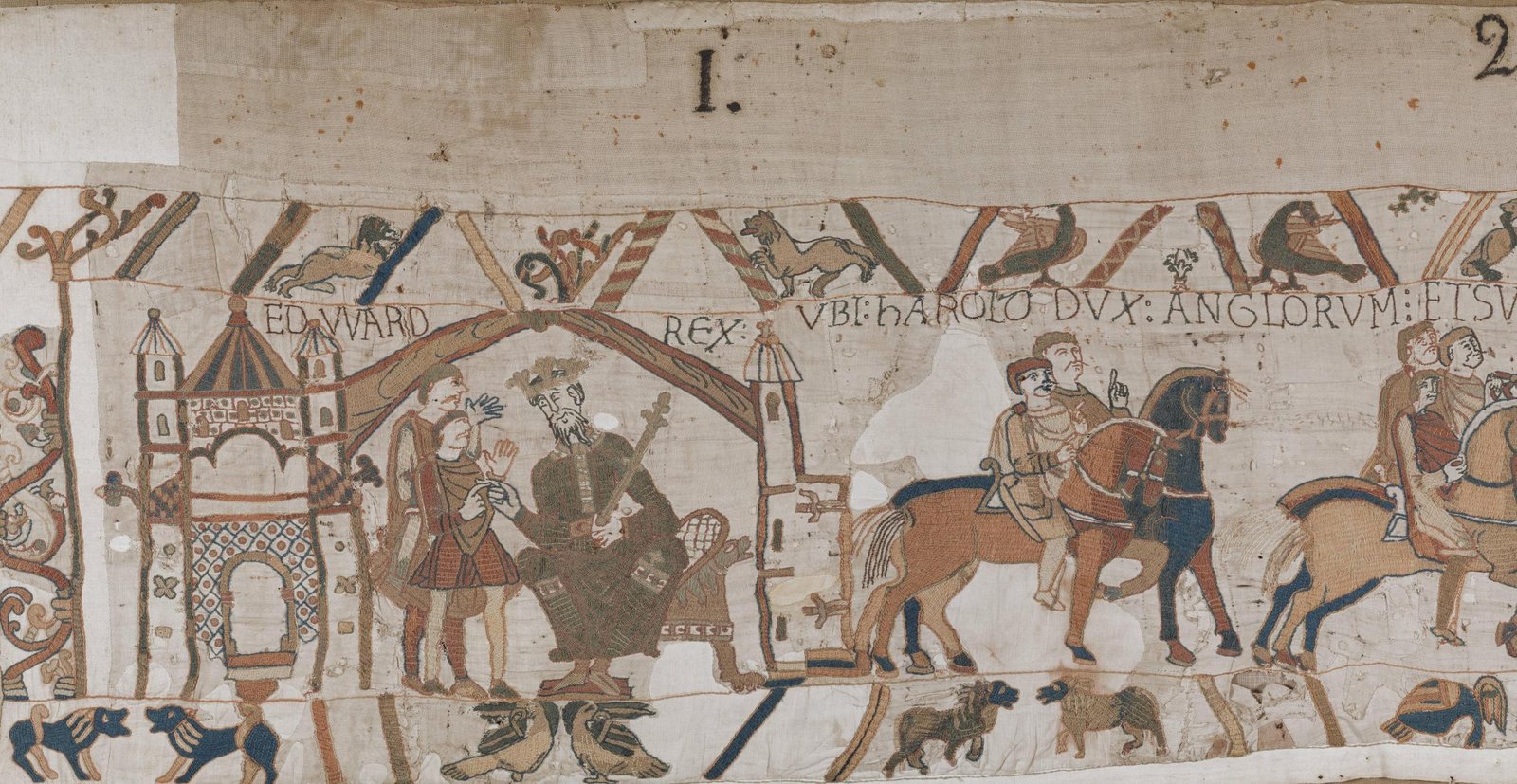
The most remarkable thing about the Bayeux Tapestry's survival is how little we know about most of it. For roughly four hundred years after its creation in the 1070s, the tapestry vanishes from the historical record entirely. We do not know where it was kept, who looked after it, or how it was stored. It simply drops out of history and reappears centuries later.
What can we say with confidence?
The secure documentary trail begins in 1476. Earlier claims about where the Tapestry was kept, how often it was displayed, or what it was originally made for remain reconstructions rather than recorded facts.
The first known mention of the tapestry comes in 1476, when an inventory of Bayeux Cathedral's treasures lists a very long and narrow strip of linen on which are embroidered figures and inscriptions depicting the conquest of England. The fact that it was in the cathedral suggests it may have been there for a long time, possibly since its creation, but we cannot be sure. Some scholars believe it was made for the cathedral in the first place, displayed around the nave during feast days, but this too is speculation.
Rediscovered by Accident
The tapestry remained in relative obscurity until 1729, when a French antiquary named Nicolas-Joseph Foucault sent a detailed drawing of the end section to a scholar in Paris. This sparked academic interest, and in 1730 the Benedictine monk Bernard de Montfaucon published a complete set of engravings of the tapestry in his monumental work on French antiquities. For the first time, scholars and the educated public across Europe could see the whole narrative. The Bayeux Tapestry began its transformation from a local curiosity into a recognised masterpiece.
It Nearly Became Wagon Covers
The French Revolution brought one of the most famous danger stories in the Tapestry's history. Contemporary and later accounts describe it being requisitioned for public use, including an episode in which it was taken for use as a covering on a wagon before being recovered. Another account says it was nearly cut up for a civic display. Whatever the precise sequence, local intervention helped return it to safety during a period when many historic objects were at risk.
Napoleon's Propaganda Weapon
In 1803, Napoleon Bonaparte had the tapestry brought to Paris and displayed in the Musée Napoleon (now the Louvre) as propaganda for his planned invasion of England. The parallels were obvious and deliberate: just as William had crossed the Channel and conquered England in 1066, Napoleon intended to do the same. The tapestry drew large crowds and became widely known for the first time as a symbol of successful Channel crossings. When Napoleon's invasion plans collapsed after the Battle of Trafalgar in 1805, the tapestry was returned to Bayeux. It had served its propaganda purpose, but it had also introduced the tapestry to a much wider audience.
Rescued, Then Damaged by Its Rescuers
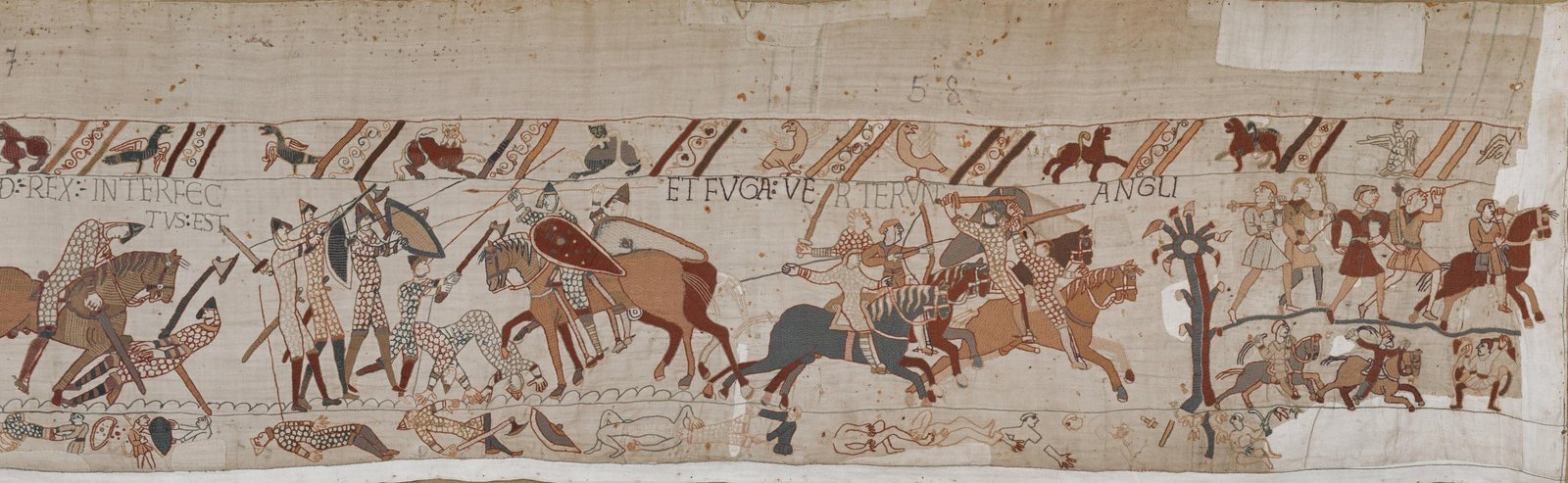
The 19th century brought both scholarly attention and intervention. In 1818 the Society of Antiquaries of London commissioned a complete set of coloured drawings, which remain an important record of the Tapestry's condition. Restoration work also altered some areas. The surviving final inscription, ET FUGA VERTERUNT ANGLI ("and the English turned in flight"), is not regarded as fully secure evidence for the original ending and has been associated with later restoration. The famous arrow near Harold's eye has also been questioned, although its history remains debated.
The tapestry was displayed in increasingly unsuitable conditions throughout the century, hung vertically on walls where it sagged under its own weight, exposed to dust, light, and the fingers of curious visitors. By the late 1800s, concerns about its deterioration led to the construction of a purpose-built gallery in Bayeux, where it was displayed behind glass in a long, climate-controlled case.
Himmler Wanted It
During the Second World War, the tapestry faced danger again. After the fall of France in 1940, the German occupiers took a keen interest in it. Heinrich Himmler, head of the SS, regarded the tapestry as evidence of Germanic (specifically Viking-descended Norman) superiority, and the SS Ahnenerbe, its pseudo-archaeological research division, studied it extensively.
In 1944, as the military situation in France changed rapidly, the Tapestry was moved to Paris and kept at the Louvre. Later accounts have linked Himmler and the SS with plans to take possession of it, though the exact intentions are not equally well documented in every retelling. What is clear is that the Tapestry survived the occupation and was returned to Bayeux after the war.
The official British Museum publication covers not only what the tapestry depicts but the full story of the object itself, including its long and precarious survival. Written by the museum's own curators and reproducing the entire tapestry in extraordinary detail, it is the most complete account of the tapestry currently available.
Browse Bayeux Tapestry Books →The Modern Era
Since 1983, the tapestry has been displayed in a dedicated museum in Bayeux, the Musée de la Tapisserie de Bayeux, in a specially designed curved gallery that allows visitors to walk alongside its entire 70-metre length. The environment is carefully controlled for temperature, humidity and light levels. The tapestry is no longer touched, moved or exposed to direct sunlight.
Its condition, while stable, shows the scars of its long history. There are patches, repairs, faded areas, and sections where the original embroidery has been lost or replaced. The very end of the tapestry is missing, probably several metres, and scholars believe the lost section depicted William's coronation. Despite these losses, the tapestry remains in remarkably good condition for an object approaching its thousandth birthday.
Its journey to the British Museum in 2026, only the second time it has left France in modern history, required years of diplomatic negotiation and extraordinary conservation planning. It is, by any measure, one of the most precious and fragile cultural objects in the world, and the fact that it has survived at all is a story almost as improbable as the one it tells.
Sources
This article draws on Lucien Musset, The Bayeux Tapestry for the history of the tapestry's documentation and restoration, David M. Wilson for the 19th and 20th century history, and Bayeux Tapestry Museum materials for its current conservation and display.
Think You Can Crack the Case?
Try our free Bayeux Tapestry logic puzzle, a kids' mystery and a grown-up detective challenge, both built around real facts from the tapestry.
Related Reading
What Is the Bayeux Tapestry?
Start with a simple explanation of what the tapestry is and why it matters.
Read the simple guide →Who Made the Tapestry?
Explore the theories about its patron, makers and purpose.
Read who made it →Continue exploring the Tapestry
Its survival story makes more sense when you connect the object itself with its makers, its scenes and the chance to see it today.
What is the Tapestry?
Start with the object itself, how it was made and what it shows.
Read the simple guide →Who made it?
Explore the evidence for patronage, English manufacture and Canterbury.
Investigate its origins →See it in London
Prepare for the British Museum exhibition and make the most of your visit.
Plan your visit →Explore all 58 scenes
Follow the complete embroidered story from Edward to Hastings.
Open the scene guide →