Harold Godwinson
The last Anglo-Saxon king of England
Battle of Hastings
Born into Power
Harold Godwinson was born around 1022, the second son of Godwin, Earl of Wessex, the most powerful nobleman in England. The Godwin family dominated English politics for a generation. Godwin himself had risen from relatively modest origins to become the chief advisor to King Cnut and then to Edward the Confessor. He married Gytha, a Danish noblewoman with connections to Scandinavian royalty, and together they produced a brood of ambitious, capable sons who between them controlled most of England's earldoms.
Harold grew up in a world of aristocratic power politics, where family alliances, land ownership and military reputation determined everything. He learned to fight, to govern, and to navigate the treacherous currents of the English court, where his father's relationship with King Edward was often strained to breaking point.
From Earl's Son to the Man Behind the Throne
In 1051, a political crisis between Godwin and King Edward led to the entire Godwin family being exiled. They fled to Ireland and Flanders, regrouped, and returned the following year with an armed fleet. Edward, unable to resist, was forced to restore them. Godwin died in 1053, reportedly collapsing at a royal feast, and Harold inherited the earldom of Wessex, the richest and most important in England.
Over the next decade Harold became the dominant figure in English politics. He led military campaigns against the Welsh, personally defeating and killing the Welsh king Gruffydd ap Llywelyn in 1063. He governed effectively, maintained order, and built a reputation as a capable soldier and a shrewd political operator. By the early 1060s he was effectively running England on behalf of the ageing, increasingly pious Edward.
The Trip That Changed Everything
Sometime around 1064 or 1065, Harold crossed the Channel to Normandy. Why he went is one of the great disputed questions of medieval history. Norman sources, writing after the Conquest, claimed Edward sent Harold to confirm William as his heir. English sources are largely silent or suggest Harold was on a private mission, possibly to secure the release of family members held hostage by William since the 1050s.
Whatever the reason, the trip went wrong from the start. Harold was shipwrecked on the coast of Ponthieu and seized by the local count, who held him for ransom. William intervened, secured Harold's release, and brought him to the Norman court. Harold accompanied William on a military campaign in Brittany, where he distinguished himself, and William presented him with arms, a gesture that could be interpreted as making Harold his vassal.
Then came the oath. Harold swore an oath to William, touching holy relics, the most binding form of promise known to the medieval world. The exact content of the oath is unknown. Norman sources say Harold swore to support William's claim to the English throne. The Bayeux Tapestry shows the act but never says what was sworn. Whether Harold was coerced, whether he understood the implications, and whether the oath was made under duress that invalidated it, are questions that were argued passionately at the time and have been argued ever since.
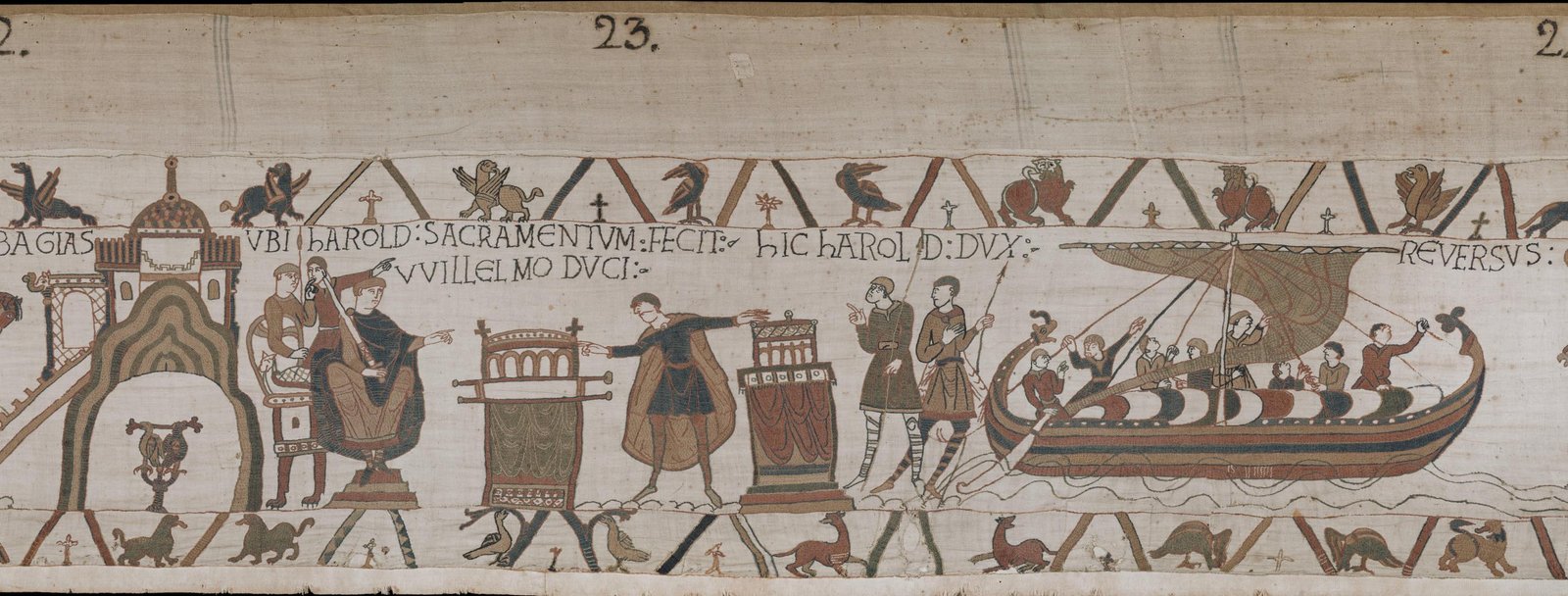
Follow Harold through the Bayeux Tapestry
Harold is one of the central figures in the embroidery. You can follow him from Edward's court, through Normandy and the oath, to his enthronement and the final battle scenes.
A Crown He Would Hold for Nine Months
Edward the Confessor died on 5 January 1066. According to English sources, the dying king reached out and commended his kingdom and his wife to Harold's protection. The Witan, the council of English nobles, chose Harold as king, and he was crowned the next day. By English law and custom, the Witan had every right to choose the king, and a deathbed bequest from the previous king carried enormous moral weight.
The Normans saw it differently. To them, Harold had sworn a sacred oath to support William, had broken it by taking the crown himself, and was therefore a perjurer and a usurper. The pope agreed with the Norman position and sent William a papal banner to carry into battle. Harold was fighting not just for a kingdom but against a charge of sacrilege.
Three Battles. Nine Months. One Kingdom Lost.
Harold's nine-month reign was dominated by military crisis. He spent the spring and summer watching the Channel for William's invasion, holding his army and fleet in readiness along the south coast. When supplies ran out in early September, he was forced to disband them.
Within days, Harald Hardrada of Norway invaded the north. Harold marched his army 185 miles in four days and destroyed the Norwegian army at Stamford Bridge on 25 September, a stunning victory that effectively ended the Viking Age in England. But before he could rest, news arrived that William had landed at Pevensey.
Harold turned his exhausted army around and marched south. He arrived at Senlac Ridge on 13 October and deployed for battle the next morning. The English fought with extraordinary determination, holding the shield wall for most of the day against repeated Norman assaults. But the feigned retreats thinned the line, the arrow storm took its toll, and by dusk the English position was crumbling.
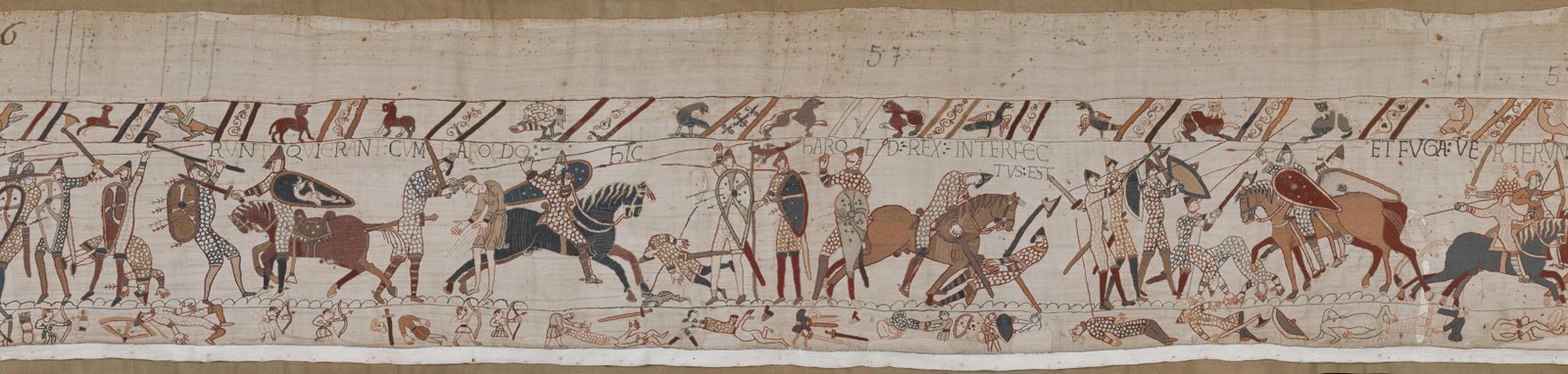
Harold died on the battlefield, the last crowned Anglo-Saxon king of England. His exact manner of death is uncertain. The Bayeux Tapestry's famous image of a figure with an arrow in or near his eye may or may not depict the moment. Later sources describe him being cut down by a group of Norman knights. His body was so badly mutilated that it could only be identified by his lover, Edith Swan-Neck, who recognised marks on his body that only she would know.
Ian Pusey examines the decisions, the landscape, and the sequence of events on 14 October 1066 with forensic care, asking whether the outcome at Hastings was inevitable or whether Harold came far closer to winning than history suggests. For anyone who has just read Harold's story and wants to understand exactly how it ended, this is the most probing account available.
Explore Battle of Hastings Books →Legacy
Harold ruled for 282 days. In that time he won one of the greatest victories in English history at Stamford Bridge and suffered one of its most consequential defeats at Hastings. He was brave, capable, and unlucky. Had William's fleet sailed a fortnight earlier, or had Harold been given a week longer to rest and reinforce after Stamford Bridge, the outcome at Hastings might have been very different.
History, as always, was written by the winners. Norman sources portrayed Harold as a perjurer who got what he deserved. But the Bayeux Tapestry, commissioned by the winning side, treats him with surprising respect. He is shown as brave, strong, heroic, even noble. He is called REX, king, throughout the battle scenes. The tapestry's anonymous designer understood that the story of 1066 is a tragedy, and Harold is its tragic hero, a great man destroyed not by weakness but by an oath he may never have freely given.
Sources
This article draws primarily on Frank Barlow, The Godwins for the biographical details, the Anglo-Saxon Chronicle for the English account of 1066, William of Poitiers for the Norman perspective, and Bayeux Tapestry Museum materials for the tapestry's depiction of Harold.
Think You Can Crack the Case?
Try our free Bayeux Tapestry logic puzzle, a kids' mystery and a grown-up detective challenge, both built around real facts from the tapestry.
Related Reading
The Battle of Hastings
Read about the battle in which Harold Godwinson lost his crown and his life.
Read the battle guide →Harold's Oath
Explore the tapestry scenes that show Harold's controversial oath to William.
Explore Harold's oath →Timeline of 1066
Follow the dramatic year from Edward the Confessor's death to William's coronation.
View the timeline →Where to go next
Harold's story connects almost every major strand of 1066. Continue with the part that interests you most.
See Harold in the Tapestry
Follow his story through the complete 58-scene guide.
Explore all 58 scenes →Understand Hastings
See how the final battle developed and why the English line eventually broke.
Battle of Hastings →Read more about 1066
Browse Bayeux Tapestry and Battle of Hastings books in one place.
Browse books →Historic Britain: Harold II
See our own design celebrating Harold as the last Saxon king of England.
View at Historic Britain →