The Battle of Hastings
14 October 1066. The day England changed hands
near Hastings
Two Armies. Two Completely Different Ways of Fighting.
The two armies that faced each other on Senlac Ridge on 14 October 1066 fought in completely different ways. Understanding the difference is the key to understanding the battle.
Harold's English army fought entirely on foot. Its core was the housecarls, professional household warriors equipped with mail armour, kite shields and the fearsome two-handed Danish axe, a weapon capable of splitting a horse's skull with a single blow. Around them stood the fyrd, part-time soldiers drawn from the landholding class, less well equipped but experienced and motivated. The English formed a dense shield wall along the ridge, shields overlapping, presenting an almost impenetrable barrier to frontal assault. The shield wall was a defensive formation, and the English had no cavalry.
William's Norman army was built around mounted knights, heavily armed horsemen who charged with couched lances, a relatively new tactic that concentrated the horse's momentum behind the lance point. Supporting them were archers and crossbowmen, and Norman infantry. The Normans were an offensive army, designed to break enemy formations through shock and missile fire.
The exact size of both armies is unknown. Modern estimates generally put each side at roughly 7,000 to 8,000 men, though some historians argue for higher or lower figures. What is clear is that neither side had an overwhelming numerical advantage.
Harold Chose His Ground Well
Harold chose his position carefully. Senlac Ridge, about seven miles north-west of Hastings, is a narrow ridge with steep slopes on both flanks and a gentle forward slope to the south. The English shield wall was deployed along the crest, perhaps 600 to 800 metres wide, anchored by the steep ground on either side. It was an excellent defensive position. William would have to attack uphill.
Behind the ridge, to the north, the ground drops away steeply. This was both an advantage, it protected the English rear, and a trap. If the army broke, there was limited room to retreat.
14 October 1066
The battle began at around nine in the morning, an unusually late start by medieval standards, probably because William needed time to deploy his forces. He arranged his army in three divisions: Bretons on the left, Normans in the centre, and French and Flemish on the right. Each division was deployed in three lines: archers in front, infantry behind them, and cavalry at the rear.

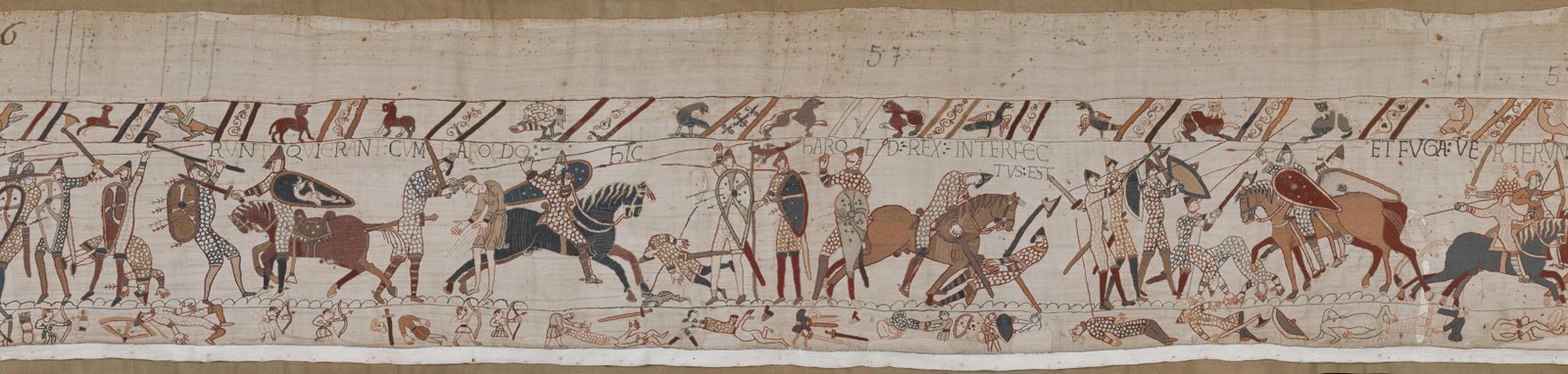
Follow the battle in the Bayeux Tapestry
The final section of the embroidery compresses a long and chaotic battle into a rapid sequence of charges, deaths, collapsing formations and fleeing soldiers.
The archers opened the battle, shooting uphill into the shield wall. The angle worked against them, most arrows flew over the English line or thudded into shields. The infantry advanced next, climbing the slope into a wall of axes and swords. They were repulsed. Then the cavalry charged, and they too were driven back by the shield wall. The English line held.
On the Norman left, the Breton division broke and fled down the hill. Part of the English right wing, seeing them run, broke ranks and pursued. This was a critical error. Once off the ridge, the English pursuers were cut off and destroyed by Norman cavalry wheeling back on them.
It was at this point that a rumour swept the Norman army that William had been killed. Panic began to spread. William rode through his troops, pushed back his helmet to show his bare face, and rallied them. Bishop Odo, his half-brother, charged into the fleeing troops and turned them around. The crisis passed.
William now tried a deliberate tactic that would prove decisive: the feigned retreat. Norman cavalry would charge the shield wall, then turn and pretend to flee. English soldiers, thinking the Normans were broken, would break ranks to pursue, only to be cut down when the cavalry wheeled and counter-charged. This trick worked repeatedly, thinning the English line each time.
By late afternoon the English army was shrinking. Harold's brothers Leofwine and Gyrth had been killed earlier in the battle. The housecarls, Harold's best troops, were falling one by one. William ordered his archers to shoot high, lobbing arrows over the shield wall to fall among the men behind it.
How did Harold die?
This remains uncertain. The famous arrow-in-the-eye interpretation is possible, but the Tapestry itself does not make the identification completely clear. The inscription states that King Harold was killed, while the figures beneath it have been interpreted in different ways.
The safest reading is that the embroidery clearly records Harold's death, but the exact mechanism remains disputed.
As dusk approached, Harold was killed. The exact circumstances remain one of history's great arguments. The Bayeux Tapestry shows two figures beneath the words HIC HAROLD REX INTERFECTUS EST, one clutching at an arrow near his eye, another being struck down by a mounted knight. Which is Harold, or whether both show the same man in consecutive moments, is still debated. Later written sources describe him being hacked apart by a group of knights, one of whom was reportedly disgraced for mutilating the body.
With Harold dead, the English army collapsed. The surviving housecarls fought to the last around the fallen king. The fyrd broke and ran northward into the darkness. The Norman cavalry pursued, though the pursuit was costly. In one incident, a group of fleeing English made a stand at a steep ravine, possibly the feature later known as the Malfosse, and inflicted heavy casualties on their pursuers.
Ian Pusey takes the familiar story of 14 October 1066 apart and reassembles it from the ground up, examining the landscape, the sources, and the decisions that shaped the outcome. If this article has left you asking questions about how and why the battle unfolded the way it did, this book provides the most searching answers currently available.
Explore Battle of Hastings Books →The Aftermath
The Battle of Hastings was over by nightfall. Harold, the last crowned Anglo-Saxon king of England, lay dead on the ridge along with his brothers and the flower of the English aristocracy. William had won the battle, but he had not yet won England. It would take years of campaigning, castle-building and savage repression before the Conquest was truly complete.
The battle's significance is hard to overstate. It replaced one ruling class with another, transformed English culture, language and law, and connected England permanently to the continent. The English language absorbed thousands of French words. The feudal system reshaped land ownership. Norman castles, first the motte-and-bailey earthworks shown in the tapestry and later the great stone keeps, transformed the landscape. The echoes of 14 October 1066 are still audible in modern Britain, nearly a thousand years later.
Sources
This article draws on William of Poitiers, Gesta Guillelmi for the detailed Norman account of the battle, the Anglo-Saxon Chronicle for the English perspective, and David C. Douglas, William the Conqueror for the modern analysis. Tapestry references are based on Bayeux Tapestry Museum materials.
Think You Can Crack the Case?
Try our free Bayeux Tapestry logic puzzle, a kids' mystery and a grown-up detective challenge, both built around real facts from the tapestry.
Related Reading
Harold Godwinson
Learn about the last Anglo-Saxon king and his role in the events of 1066.
Read about Harold Godwinson →Scene by Scene
Follow the Bayeux Tapestry's visual account of the road to Hastings.
Explore the tapestry scenes →Timeline of 1066
See how the battles, claims and invasions unfolded across the year.
View the 1066 timeline →Continue the story of 1066
The battle makes more sense when you follow the people, the wider year and the Tapestry together.
Harold Godwinson
Follow the English king from Normandy to the crown and his final stand at Hastings.
Read about Harold →William of Normandy
See the battle from the perspective of the man who planned the invasion.
Read about William →Battle books
Browse books focused on Hastings, military decisions and the wider Norman Conquest.
Browse Hastings books →Historic Britain: Where War Goes
A darker 1066 design inspired by Stamford Bridge, Hastings and the human cost of conquest.
View at Historic Britain →