William, Duke of Normandy
The man who crossed the Channel and changed England forever
Falaise, Normandy
Born a Bastard
William was born around 1028 in Falaise, in the heart of Normandy. His father was Robert I, Duke of Normandy, a powerful and ambitious ruler descended from Viking settlers who had carved out a duchy in northern France a century earlier. His mother was Herleva, the daughter of a local tanner, a woman of no political standing and no formal connection to the ducal court. Robert and Herleva were never married. From the moment of his birth, William carried the label that would follow him through his early life and that his enemies would use against him for decades. He was William the Bastard, and he knew it.
Robert had no legitimate children. When he decided in 1035 to go on pilgrimage to Jerusalem, a dangerous journey from which many did not return, he assembled his Norman barons and made them swear to accept William as his heir. It was an extraordinary thing to ask. The barons swore. Robert set out for the Holy Land and died on the return journey, in Nicaea, in what is now Turkey. William was approximately seven years old. He was now Duke of Normandy, and he was entirely on his own.
A Childhood That Would Have Broken Most People
The years that followed were among the most dangerous a medieval ruler ever survived. The Norman barons who had sworn to accept William had no intention of being governed by an illegitimate child. Normandy descended into factional violence. William's guardians were murdered one after another. His first guardian, Gilbert of Brionne, was killed. His second, Turchetil, was also killed. His steward, Osbern, was murdered in William's own bedchamber while the boy slept nearby. At one point, William's maternal uncle Walter was reduced to hiding the child with poor peasants by night to keep him alive until morning.
William grew up in this savage environment with no security, no stability, and no certainty that he would survive to adulthood. What it gave him instead was something more durable: a ruthlessness born of necessity, a capacity for patience, and an absolute refusal to be beaten. The boy who survived Norman barons bent on his destruction would one day bring England to its knees. The experience was not incidental to his later character. It was the making of it.
Seizing Control of Normandy
By his mid-teens, William was old enough to begin fighting back. Around 1042 he came of age and started to govern in his own right, though challenges to his authority continued. In 1046 his cousin Guy of Burgundy led a major rebellion and came close to capturing William at Valognes. William escaped on horseback by night and sought help from his feudal overlord, King Henry I of France. Henry responded. At the Battle of Val-es-Dunes in 1047, the rebel barons were crushed, and William's grip on Normandy tightened for the first time.
The victory at Val-es-Dunes marked the end of William's minority. He spent the following decade systematically consolidating his power, suppressing rebellious nobles, building castles, and extending Norman influence into neighbouring territories. He was not a forgiving ruler. At the town of Alencon, whose defenders hung animal hides from the walls in a taunt about his mother's origins, William took the town and had the hands and feet of the leading citizens cut off. Nobody mocked his birth twice.
In around 1050 he married Matilda of Flanders, daughter of Count Baldwin V, one of the most powerful nobles in northern Europe. The match was politically astute and personally successful. Matilda was formidably capable, governed Normandy competently in William's absence, and remained his partner in rule until her death in 1083. Together they had at least nine children. By his early thirties, William was the undisputed master of Normandy and one of the most feared military commanders in Europe.
The Claim to England
William's connection to England was distant but real. His great-aunt Emma of Normandy had married two English kings, Aethelred the Unready and then Cnut, and through her the Norman and English royal families had been entangled for decades. Edward the Confessor, who became King of England in 1042, had spent much of his childhood in exile at the Norman court and owed a personal debt to the duchy that had sheltered him.
According to Norman sources, Edward promised William the English throne during a visit in 1051. Whether this promise was made, what form it took, and whether Edward had the authority to make it are all disputed. The English Witan, the council of nobles, had the traditional right to choose the king, and a private promise to a foreign duke was not necessarily binding. But William believed in his claim, or found it politically useful to believe in it, and he was not a man who let go of what he thought was his.
The final piece fell into place around 1064, when Harold Godwinson came to Normandy, was shipwrecked, and ended up as William's enforced guest. Harold swore an oath on holy relics to support William's claim to the English throne. Exactly what Harold swore, whether he was coerced, and whether the oath was valid are questions that were argued at the time and have been argued ever since. What is beyond dispute is that William considered the oath binding, and when Harold took the English crown for himself in January 1066, William began preparing for war.
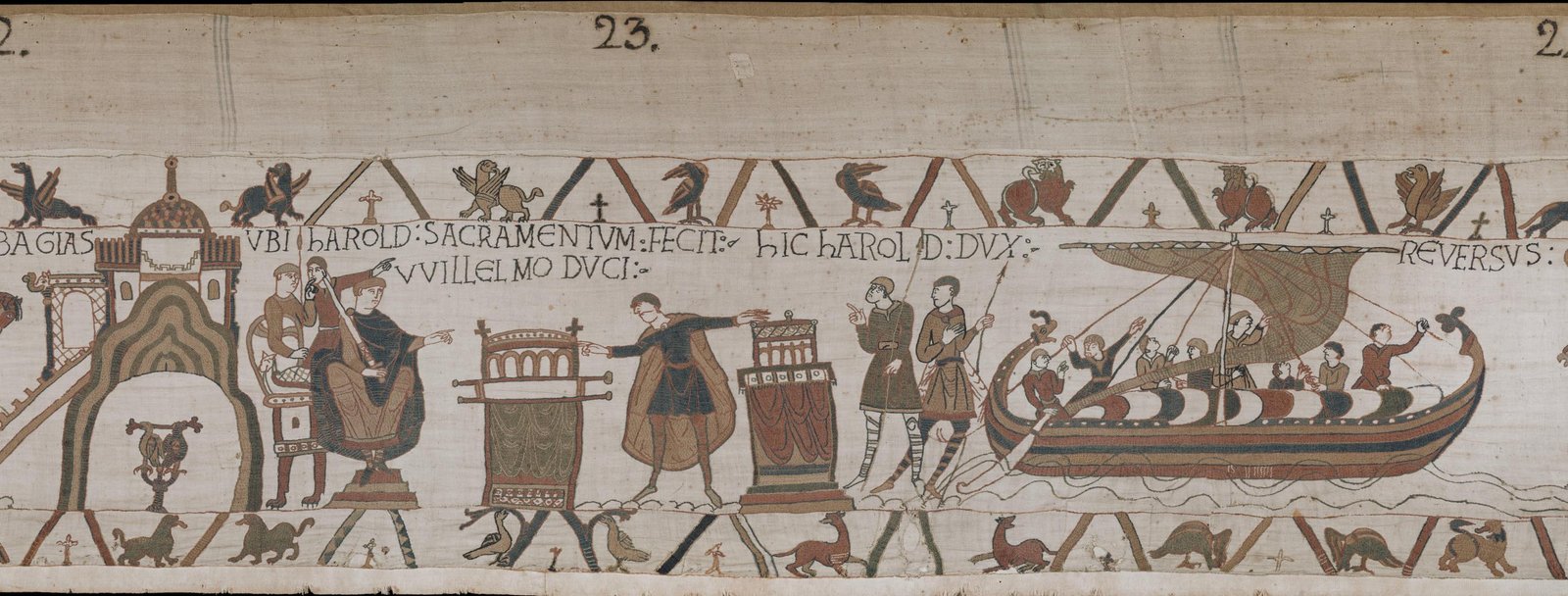
Follow William through the Bayeux Tapestry
William appears repeatedly in the embroidery as duke, commander and claimant. The sequence lets you follow how the narrative builds his case from Harold's time in Normandy to the invasion and battle.
The Invasion That Almost Did Not Happen
William spent the first half of 1066 assembling one of the largest invasion forces the medieval world had seen. He recruited knights and soldiers from across Normandy, Brittany, Flanders, and further afield, promising them land in England in return for service. He obtained papal blessing for the invasion, a considerable diplomatic achievement that cast Harold as a perjured usurper and William as a righteous claimant fighting under God's banner. He commissioned a fleet of around 700 ships to carry his army across the Channel.
Then he waited. The winds were wrong throughout the summer of 1066. William's army sat at the mouth of the Dives river for weeks, then moved to Saint-Valery-sur-Somme seeking a more favourable position. The delay was agonising. Men fell ill. Supplies ran low. The army grew restless. William, according to contemporary sources, maintained discipline and morale through a combination of personal authority and careful management of his troops' expectations. On 27 September the wind finally turned. The fleet sailed overnight and landed at Pevensey on the Sussex coast on 28 September. There was no English force waiting for them. Harold was 250 miles away in Yorkshire, battered from his victory at Stamford Bridge two days earlier.
Fourteen October 1066
William built fortifications at Pevensey and Hastings and began ravaging the local countryside, deliberately provoking Harold into a response. It worked. Harold force-marched his exhausted army south, arrived near Hastings on the evening of 13 October, and deployed along Senlac Ridge the following morning. The battle that followed lasted all day, an unusually long engagement for the period, and its outcome was far from certain for much of it.
William's tactical management of the battle was sophisticated. When the Norman left flank broke early in the afternoon and English soldiers pursued them off the ridge, William recognised both the danger and the opportunity. He rallied his troops, and the fleeing cavalry turned on the pursuing English. A rumour spread that William had been killed. He rode along the line, pushed back his helmet to show his face, and restored order. He then used the same tactic deliberately, ordering feigned retreats to lure the English shield wall apart and destroy the isolated pursuers. By dusk the English line had thinned beyond recovery. Harold was killed. The army collapsed. England had a new ruler.
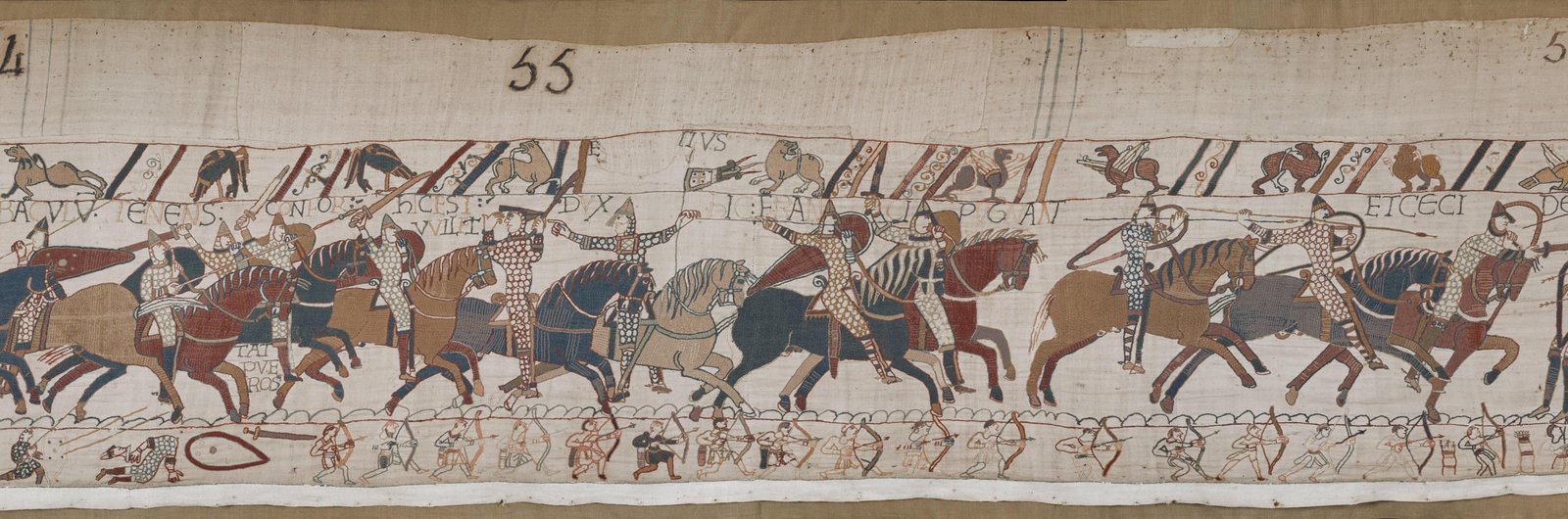
Conqueror and King
William was crowned King of England in Westminster Abbey on Christmas Day 1066. The ceremony did not go smoothly. When the congregation shouted their acclamation, the Norman guards outside mistook the noise for a riot and set fire to nearby buildings. The congregation panicked. William, by one account, was left shaking at the altar. It was an inauspicious beginning, but it did not last long.
The years that followed were defined by the systematic replacement of the English ruling class with Normans. English earls and thanes were dispossessed. Norman lords were installed in their place, each holding land directly from the king in exchange for military service. A new network of castles, beginning with simple motte-and-bailey earthworks and eventually developing into the great stone fortresses that still dominate the English landscape, enforced Norman authority across the country.
English resistance was real and prolonged. In 1069 a Danish fleet allied with English rebels took York. William's response was the Harrying of the North, one of the most brutal acts of the Conquest, a systematic campaign of burning, killing, and destruction across Yorkshire and the surrounding area designed to eliminate the capacity for further rebellion. The Domesday Book, compiled twenty years later, still records vast areas of the north as waste. The human cost was enormous. William did not apologise for it. He was not that kind of king.
Marc Morris's authoritative account of the Norman Conquest is the best modern treatment of William's victory and its consequences, examining the events of 1066 from both sides of the Channel and tracing how the Conquest transformed every aspect of English life. If William's story has left you wanting more, this is the book to reach for next.
Explore Battle of Hastings Books →The Domesday Book and the Weight of Power
In 1085, faced with the threat of a Danish invasion that never materialised, William ordered the most ambitious administrative survey ever undertaken in medieval Europe. Commissioners were sent to every county in England to record who held every piece of land, what it was worth, and who had held it before the Conquest. The results were compiled into what became known as the Domesday Book, a name given to it by the English because, like the Day of Judgment, there was no appeal against its findings.
The Domesday Book is one of the most remarkable documents in English history, and it is also a testament to William's character. No other medieval ruler would have attempted it. It required extraordinary organisational capacity, an iron grip on a large and recently conquered territory, and a genuine belief that the king had both the right and the responsibility to know exactly what his kingdom contained. William was in his late fifties and in poor health when he ordered it. He never saw the finished record.
The Death of the Conqueror
William spent the last years of his life fighting on two fronts, managing rebellion in England and defending Normandy from the growing ambitions of the French king Philip I. His final campaign was against the town of Mantes in the French Vexin, a border territory that Philip had seized. In the summer of 1087, William's forces burned the town. During the attack, his horse stumbled and he suffered severe internal injuries, possibly from the saddle pommel. He was carried to Rouen and lingered for several weeks, dying on 9 September 1087, aged around fifty-nine.
His death was as undignified as medieval deaths tended to be. His attendants stripped the body and fled to secure their own estates. The corpse was left largely unattended. When it was finally taken to his burial church at Saint-Etienne in Caen, the building proved too small for the coffin. The body, already decomposing in the September heat, burst during the attempt to force it into the stone tomb. Contemporary accounts do not spare the detail. The man who had conquered England was buried in chaos, his great abbey filled with the smell of his own death.
He left Normandy to his eldest son Robert and England to his second son William, later known as William Rufus. His third son Henry received five thousand pounds in silver. Henry would eventually take both England and Normandy for himself, but that is another story.
Legacy
William ruled England for twenty years. In that time he replaced the entire English ruling class, transformed the country's language, law, architecture, and governance, and connected England permanently to continental Europe in ways that shaped its history for centuries. Every English and British monarch since William has been his descendant. The Norman French that flooded into English after 1066 gave the language much of its richness and its characteristic doubling, where Old English and Norman French words for the same thing survive side by side. We eat pig but we serve pork. We raise cows but we eat beef. We speak to our neighbours in English and to our lawyers in a language that still carries the echo of Normandy.
The Bayeux Tapestry, commissioned by his half-brother Odo, tells William's story from the Norman perspective. He appears throughout as a decisive, commanding figure, the rightful heir wronged by Harold's perjury and vindicated by God on the battlefield at Hastings. Whether you accept that version of events depends on where you stand. What is not in dispute is that William of Normandy was one of the most consequential individuals in the history of the English-speaking world, and that the story the tapestry tells would have ended very differently without him.
Sources
This article draws primarily on David C. Douglas, William the Conqueror for the biographical framework, William of Poitiers, Gesta Guillelmi for the Norman account of the Conquest, the Anglo-Saxon Chronicle for the English perspective, and Bayeux Tapestry Museum materials for the tapestry's depiction of William.
Think You Can Crack the Case?
Try our free Bayeux Tapestry logic puzzle, a kids' mystery and a grown-up detective challenge, both built around real facts from the tapestry.
Related Reading
Harold Godwinson
The man William defeated at Hastings, his rise to power, and his nine-month reign as England's last Anglo-Saxon king.
Read about Harold →The Battle of Hastings
A full account of the battle on 14 October 1066, from the opening arrow storm to Harold's death at dusk.
Read the battle guide →Timeline of 1066
Follow the entire year month by month, from Edward the Confessor's death to William's coronation on Christmas Day.
View the timeline →Continue the story
William's story connects the Normandy journey, the invasion, the battle and the transformation of England after 1066.
Harold Godwinson
Read the same crisis from the perspective of the English king William defeated.
Read about Harold →Battle of Hastings
Follow the fighting on 14 October from the first attacks to the collapse of the English line.
Read the battle guide →Explore the Tapestry
Follow William, Harold and the invasion through the complete 58-scene sequence.
Explore all 58 scenes →