How Did Harold Die?
The arrow in the eye is famous. The evidence is much less certain.
What the Bayeux Tapestry Actually Shows
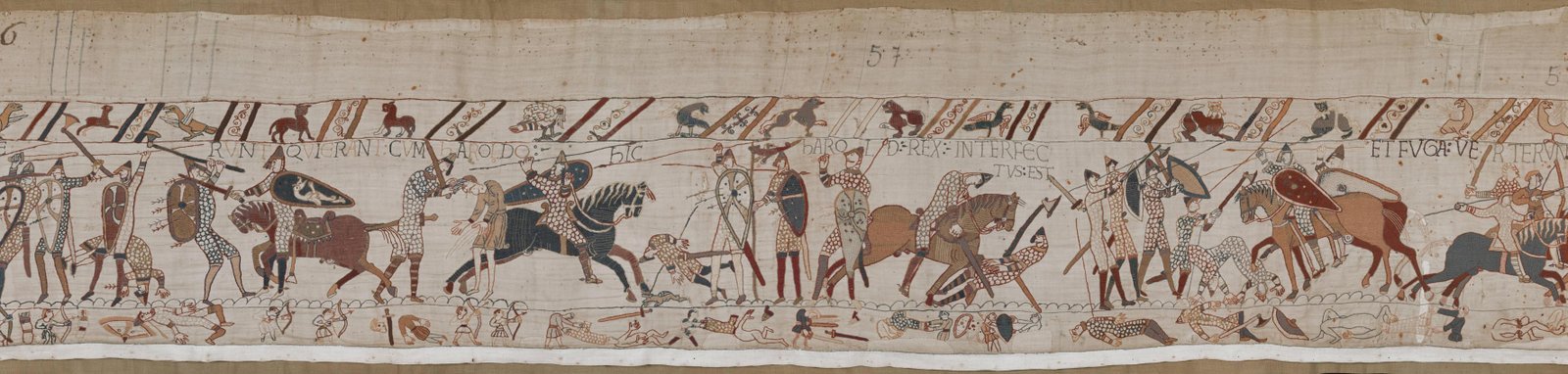
Near the end of the Battle of Hastings, the Tapestry records the death of King Harold. This is one of the most famous passages in the whole embroidery and also one of the most disputed.
Under the inscription identifying Harold's death, one standing figure appears with a long object at or near his face, while immediately beside him another English figure is shown falling as a mounted Norman strikes down with a sword.
The difficulty is that the embroidery does not label either individual figure with Harold's name. The inscription stretches across the action, which means the viewer has to decide how the words relate to the two bodies beneath them.
The crucial distinction
Strong evidence: the Tapestry records Harold's death at this point in the battle.
Much weaker evidence: that the standing figure with the apparent arrow is definitely Harold, or that an arrow wound was the cause of his death.
What Does the Inscription Say?
Meaning: “Here King Harold was killed.”
The wording is extremely important because it is direct about the event but silent about the method. It does not say that Harold was shot, struck in the eye, cut down by cavalry, or killed by several men.
The inscription therefore gives us very strong evidence for Harold's death, but it does not solve the question of how he died.
The Famous Arrow in the Eye
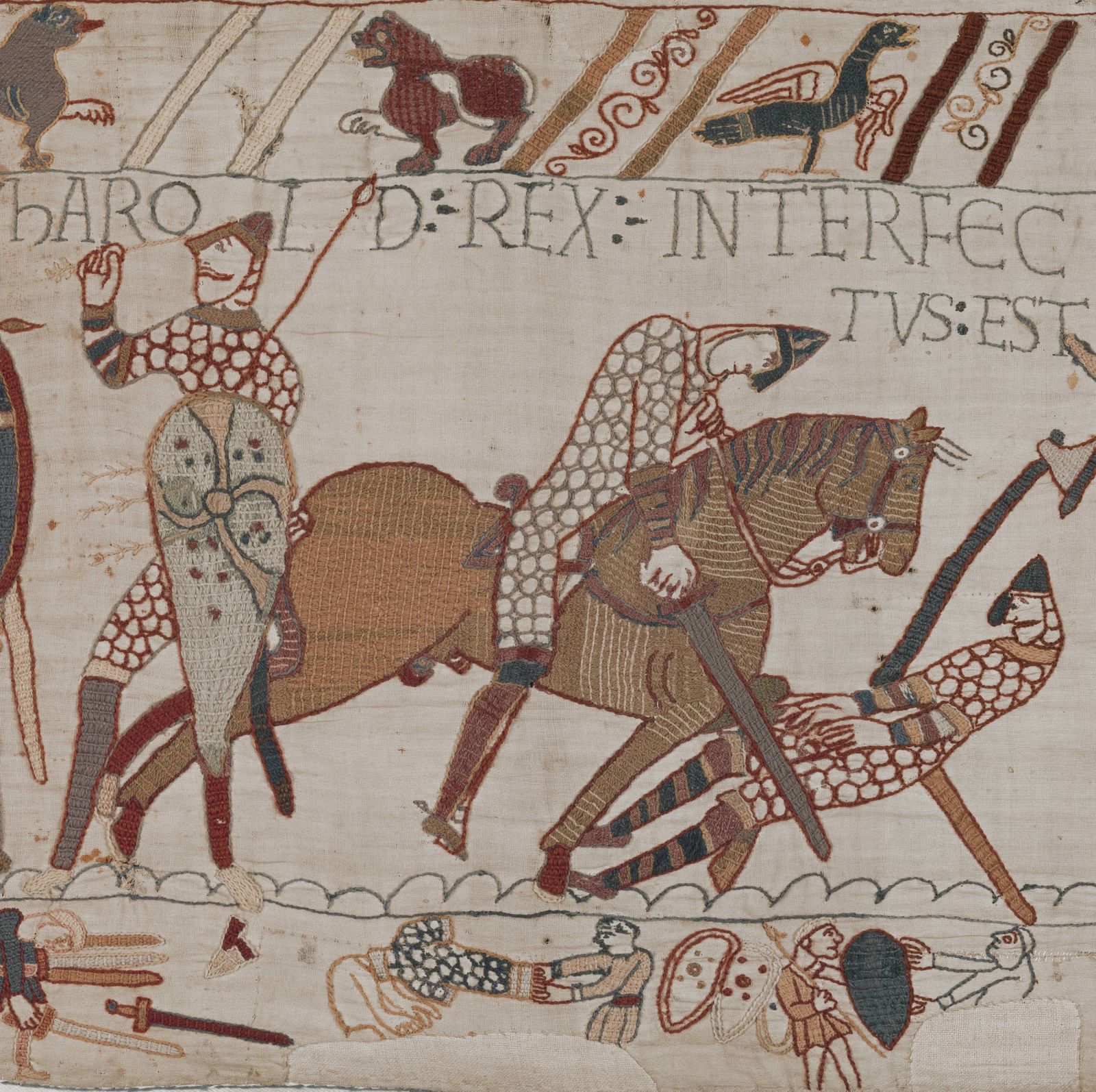
The most familiar version of Harold's death is that an arrow struck him in the eye. That image is so famous that many people assume the Tapestry states it plainly.
It does not. What the embroidery gives us is a striking but ambiguous image. The standing figure beneath the death inscription has a long object running toward the face, and that makes the traditional interpretation easy to understand. But the figure is not separately named, and the stitching in this part of the Tapestry has a complicated restoration history.
That matters because the scene we look at today is not an untouched snapshot from 1066. Repairs, re-stitching and earlier drawings all affect the discussion. None of that proves the arrow reading is wrong, but it does mean the image cannot be treated as an open-and-shut statement that Harold was killed in exactly that way.
So the arrow in the eye remains a strong and memorable interpretation, but it is still an interpretation rather than a certainty.
How strong is the arrow theory?
The arrow-in-the-eye interpretation is suggestive rather than conclusive. It fits the surviving image, but the figure's identity and the history of the stitching prevent us from treating it as certain.
What About the Man Being Struck Down?
Immediately beside the standing figure, another Englishman is shown falling as a mounted Norman attacks him with a sword. Because this action also lies beneath the Harold death inscription, some readers have identified this second figure as Harold instead.
A third possibility is that the two figures form a sequence: Harold is first wounded and then struck down. Medieval art could show successive moments involving the same person within a single visual passage, so the idea cannot simply be dismissed.
But again, the Tapestry does not tell us that this is what is happening. The two-figure reading is possible, not proven.
What Do the Written Sources Say?
Written accounts of Hastings agree that Harold died in the battle, but they do not give us one simple, universally consistent description of his final moments.
Norman accounts emphasise the collapse of the English leadership and William's victory. Later traditions became more elaborate, including stories of Harold being wounded by an arrow and then attacked by Norman warriors.
The further we move from 1066, the greater the danger of treating later storytelling as eyewitness evidence. That is why the Tapestry remains so important: it is close to the events, but even it leaves the mechanism of Harold's death unresolved.
Could Harold Have Been Killed by Several Wounds?
There is no reason a battlefield death has to involve a single neat blow. A wounded king at the centre of a collapsing shield wall could have suffered more than one injury. An arrow wound and a later sword blow are therefore not mutually exclusive possibilities.
The problem is evidence. Plausibility is not the same as proof. The Tapestry allows several readings, but it does not give us enough information to select one with certainty.
What Can We Say With Confidence?
Harold Godwinson died at the Battle of Hastings on 14 October 1066. The Bayeux Tapestry records the event explicitly and places it at the climax of the English defeat.
The famous arrow-in-the-eye interpretation is possible and visually compelling, but it should not be presented as established fact. The nearby falling figure, the history of restoration and the ambiguity of the composition all leave room for other readings.
The safest conclusion is therefore:
Harold was killed at Hastings. Exactly how he died remains uncertain.
The embroidery gives us the death. It does not give us an unquestionable cause of death.
The death of Harold is easier to understand when it is seen as part of the complete battle sequence. This illustrated guide follows all 58 scenes in order, separating what the embroidery shows from what later interpretation has added.
View the Book on Amazon →As an Amazon Associate I earn from qualifying purchases.
Sources
This article draws on Lucien Musset and David M. Wilson for discussion of the Tapestry and its restoration history, William of Poitiers for the Norman account of Hastings, and Bayeux Tapestry Museum materials for the embroidered battle sequence.
Think You Can Crack the Case?
Try our free Bayeux Tapestry logic puzzle, built around real facts from the embroidery.
Continue the story
Harold's death is the climax of the battle, but it connects directly to the man, the battlefield and the full embroidered sequence.